-
Sandra Kosorotova (EE)
-
Annelie Grimwade Olofsson (SE/DK)
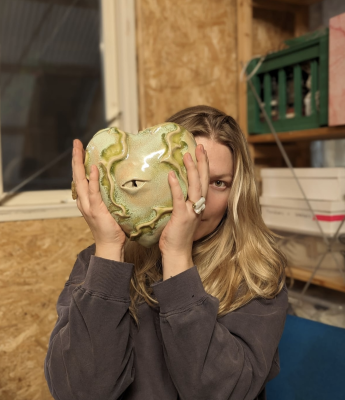
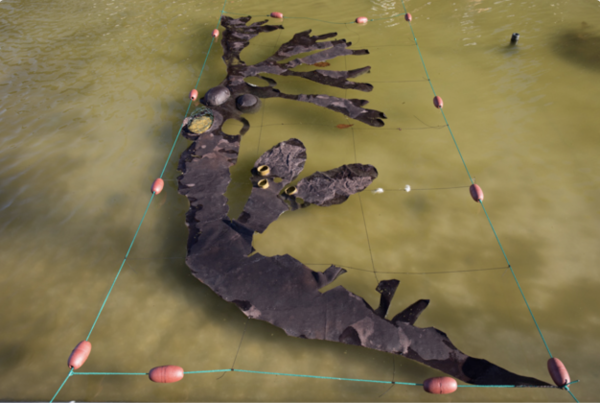
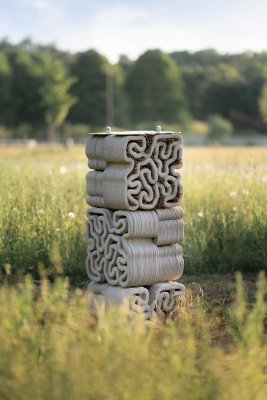
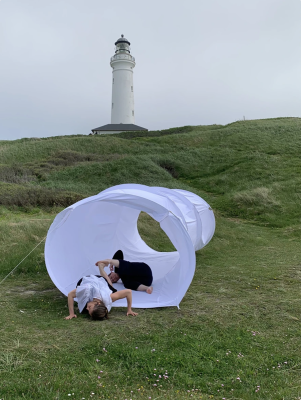
Annelie Stokke Grimwade is a Swedish Sámi-British artist based between Copenhagen and Oslo. She works across sculpture, writing and performance, transforming gathered and upcycled materials through ceramic processes into speculative artefacts, installations and participatory situations. Her practice is an active engagement with landscape, memory and more-than-human relations, often beginning with materials marked by ecological, historical and social forces. Informed by Sámi ways of knowing, animist thought, archaeology and feminist ecology, Grimwade’s work asks what the living world might teach us about relation, responsibility and the imagining of more thriving futures.
-
Augustas Lapinskas (LT)
-
LAUKKU (LV/FI/FRA/DE/SE/DK/UK)
-
Amund Sjølie Sveen (NO)
-
Linh Le (DK)
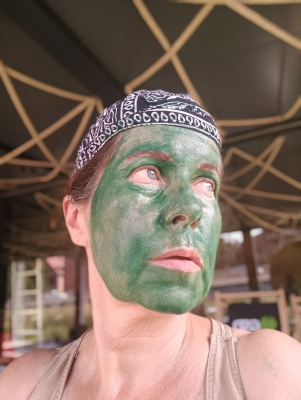
Linh Le is a performance artist and climate activist. She explores the sensuousness and philosophy of species, makes rituals for the diversity of life and builds interactive spaces for contemplation and action. As a child of freedom fighters who came to Denmark as boat refugees from Vietnam, and as a witness to their struggles in Danish society and her own experiences with racism, Linh Le is strongly called to free herself through dance and performance. Linh Le is educated in Aesthetics and Culture from Aarhus University and Performance Design & Planning from Roskilde University.
-
Inga Erdmane (LV)
-
-
Acting for Climate (EU)
-
KULTŪROS DIRBTUVĖ (LT)
-
Rūta Jumīte & Ieva Laube (LV)
-
HUMUS ECONOMICUS (SE)
-
Jenni Laiti (Sámi)
-
Malin Lobell (SE)
-
Jon Irigoyen (FI/ES)
-
Jenny Berntsson (SE)
-
Åsa Elzén (SE)
-
Kultivator (SE)
-
Cecylia Malik (PL)
-
Centrala Architects (PL)
-
Fabula (LV)
Fabula is a Riga-based creative research and design collective co-founded by Rūta Jumīte and Tīna Alise Kalēja. Through installations, placemaking workshops, publications, and participatory learning formats, Fabula explores relationships between people, places, and more-than-human life. The collective brings together ecological thinking, social participation, and artistic research to address contemporary eco-social challenges. Among its key projects is the self-published book Relational Landscapes: Navigation, a collection of guided practices by eight authors that invite to connect relationally with the living world. In 2025, Fabula organized the multidisciplinary summer school Design Activism: Interventions for Eco-Social Challenges, focused on urban bats, architectural heritage, and ecology of cracks. In 2026, the collective is developing experimental insect architecture project in Riga’s urban meadows to support biodiversity and multispecies coexistence.
-
Nana Francisca Schottländer (DK)
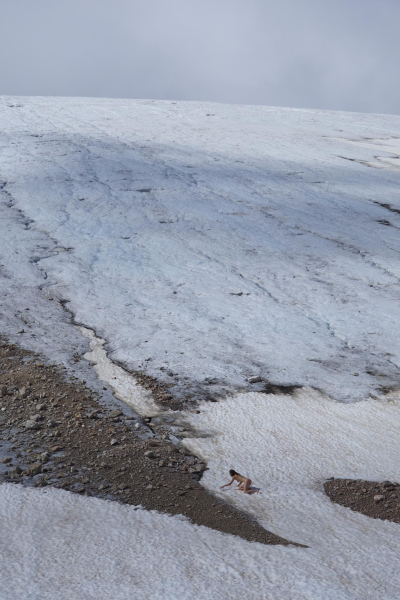
I work cross-aesthetically within the fields of choreography, performance, video and installation using the body as a living instrument for encounters, research and co-creation. The works revolve around encounters and intra-actions between humans and more-than-human bodies and worlds including rocks, fungi and plants, wind, waters and tides, soil types and larger geographical areas.
Since 2020 I focus on landscapes shapes by human intervention like extraction, production, waste and infrastructure to explore, what care and reciprocity looks like here. The works employ immersion, co-creation and long duration and draw inspiration from both scientific and academic research to develop embodied knowledge and encounters of reciprocity and co-creation.
My work formats includ performances (both participatory and solo, site specific and in art spaces), sound and video installations, exhibitions, writings and publications.
Previous performances and exhibitions (selection): Metropolis (DK), OIT (NO), Louisiana Museum of Modern Art (DK), Kunsthal Charlottenborg (DK), Roskilde Festival (DK), Heartland Festival (DK), KØS Museum (DK), The Danish National Gallery (DK), Festival of Future Nows / Hamburger Bahnhof (DE), Pergine Festival (IT), Breath Days (IT), Art Center Silkeborg Bad (DK) Liselund (DK), The Tunnelfactory (DK) amongst others. -
Agnieszka Wolodzko (PL)
I am a Polish visual artist, who uses different forms of expression. Recently, I most often create actions, collaborative workshops, installations, site-specific projects, and projects in public spaces. I am interested in a creative tension that arises on a border of a problem that I find worthy of engagement and the question of a proper and interesting aesthetic form, in which I would like to present my reflections. Using a variety of media, I do not try to become a 'specialist' in any of them. My projects are most often research-based and relate to a specific issue or a specific place. I am an extrovert rather than an introvert. Topics that interest me are public space and public sphere, urban space/habitat, the relationship between culture and nature, and possible scenarios for the future of our planet and mankind. I like collaborating with other artists and representatives from other fields. I am a person with many hats. Apart from creating visual art, I am a curator of exhibitions, and I write texts about contemporary culture.
-
Sara Hagins (DK)
Sara Hagins is a visual artist born in Aalborg. She graduated in History from the University of Copenhagen (2008) and Visual Artist from the Art School Ar.Co – Centro de Arte e Comunicação Visual in Lisbon (2015). Her practice spans textile, sound, performance and participatory formats, exploring relationships between body, care and ecology in both public and institutional spaces.
-
Sanna Kannisto (FI)
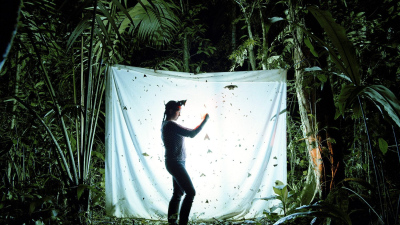
Sanna Kannisto graduated from the Aalto University in 2002. Her work merges personal narrative with photography’s documentary tradition, exploring the intersection of science and art. Through her lens, she examines both natural phenomena and her own role as observer and interpreter. Kannisto has worked in rainforests South America and lately ornithological stations across Finland and Europe. Her carefully staged images, influenced by scientific illustration and still life, depict rarely seen species with theatrical precision—highlighting both the beauty of nature and the artifice of presentation. A key element of her practice is close collaboration with scientists and researchers.
-
WunschMachine (DK)
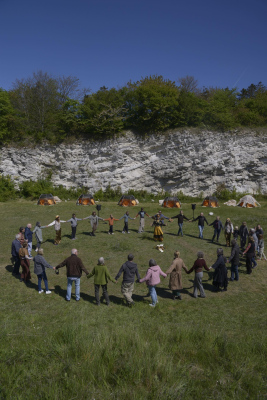
WunschMachine is a Denmark-based performing arts company creating site-specific, sensory works rooted in landscape, local communities, and lived experience. Working at the intersection of performance, dramaturgy, physical theatre, anthropology, and ritual, we develop artistic encounters that unfold beyond traditional theatre spaces—in gardens, cemeteries, quarries, villages, and public landscapes.
Our practice is grounded in deep research into specific places and their human and more-than-human inhabitants. Through participatory performances, walks, installations, and community-based projects, we explore how art can strengthen relationships between people, place, memory, and ecology. Local citizens, choirs, children, and community groups often become active collaborators in shaping the works.
Based in rural South Zealand, WunschMachine is committed to creating accessible yet experimental performance—what we call a “popular avant-garde.” Our work invites audiences to experience landscapes not as backgrounds, but as active agents, fostering embodied attention, ecological awareness, and new forms of collective imagination.
-
Höyhentämö (FI)
Höyhentämö is a community of artists producing contemporary theatre, dance and other performances. An interest and curiosity in different and emerging forms, techniques and perspectives of performing arts, and an exploratory method of working are at the core of our artistic practice. Through our work, we seek to challenge our own perceptions and habits, and we believe that in doing so we can also enter into a dialogue with viewers, other artists and the world.
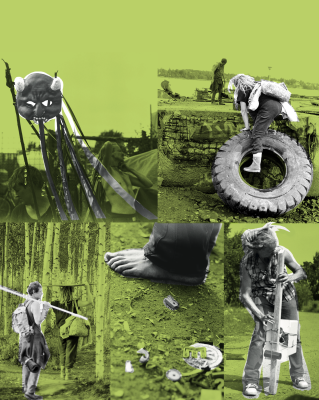
Our work is informed by an awareness and concern for our relationship to our environments (both human and non-human) and its future. It has included approaches such as community-based efforts to reimagine our lifestyle (Hunter-gatherers, 2021-2024, hoyhentamo.fi/h-g), explorations of activism and catastrophising (Katastrofiesitys/Catastrophe performance, 2022), poetic exploration of the cycles of life (butoh-performance Death and Withering, 2025), and straight-up utopias (always, in some way).
-
Helle Siljeholm (NO)
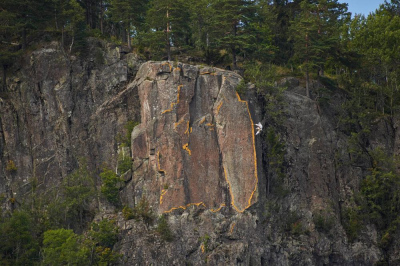
Helle Siljeholm is an artist and choreographer based in Oslo, Norway, currently pursuing a PhD at the Oslo National Academy of the Arts. Her multidisciplinary practice spans film, installation, sculpture, choreography, and performance. Her research focuses on geological entities—such as mountains and land formations—and their complex entanglements with human, natural, and cultural systems across geological time, the present moment, and possible futures. Helle’s artistic work and research are strongly influenced by a decade of collaborative artistic projects in the Middle East, particularly in Lebanon, Palestine, and Jordan.Her work has been presented at a range of international venues and festivals, including: Kunstnernes Hus, Oslo (No), Festival 10 Sentidos (ES), Reykjavik Dance Festival (IS), Walk&Talk Biennale- Gestures of Abundance (PT), Greek Film Archive (GR), Sísmograf (ES), Biennale Gherdëina 9: Parliament of Marmots (IT), Bolzano Danza / Haydn Foundation (IT), PCAI – Polygreen Arts and Culture Initiative (GR), Landart Gjerdrum (No), The Machine Is Us (MUNCH Triennale) and MUNCH (Opening) (No), VEGA | ARTS (DK), Black Box Teater, Høstscena, Rosendal Teater, Jugendstilsenteret and KUBE, Oslo Kunstforening, BEK, Akershus Kunstsenter (No), National Gallery of Iceland (IS), Ramallah Contemporary Dance Festival (PS), Athens Biennale (GR), BIPOD – Beirut International Platform of Dance (LB), Nordic Panorama – Film and Documentary Festival (SE), Hamburger Bahnhof – Museum für Gegenwart (DE).
www.themountainbody.com
-
Tellervo Kalleinen (FI)
Tellervo Kalleinen is a Helsinki-based artist and songwriter whose projects spark creative processes and generate temporary communities. Her conceptually driven participatory practice takes diverse forms, from moving image works to performance. She embraces absurdity as fertile ground for unexpected perspectives and unlikely encounters. For her, performance is a means of creating improbable situations between performer and audience, such as Recycle You, in which she recycles audience members’ outdated opinions.
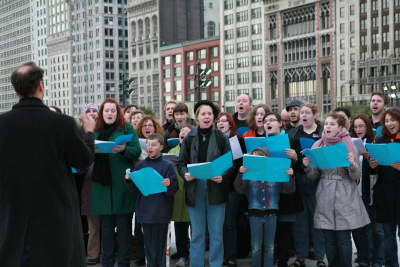
Kalleinen has been one half of the artist duo with Oliver Kochta-Kalleinen since 2002. Their Complaints Choir project has been realised in nearly 200 cities worldwide. Alongside moving image works such as The Making of Utopia, People in White and Archipelago Science Fiction, they have realised several public art commissions. Their most recent work is The Most Valuable Clock in the World as part of Oulu2026, the European Capital of Culture. The large wind-up mechanical-electronic marvel displays valuable everyday moments donated by locals, framed by slow moments from local nature – phenomena, species and habitat types that are vulnerable to climate change or otherwise under threat.
-